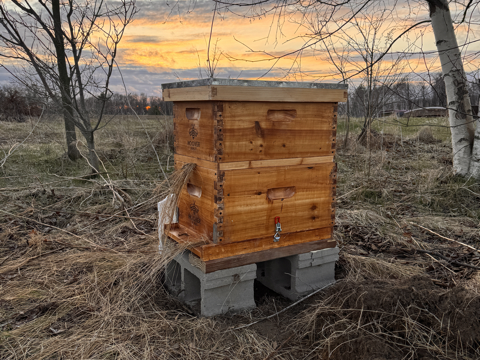
I’ve known for a long time that if we are going to have a large orchard, we’d eventually want honey bees to help pollinate the apple trees and many of the other things we’re growing. With the orchard planting coming soon, we decided it was the perfect time to dive into bee keeping and gain a better understanding of what is takes to care for a hive.
While pollination is one of our main goals, we’re also interested in eventually harvesting and selling honey. This first season, however, is all about learning. After spending some time reading, talking with friends and family who keep bees, and doing a lot of planning, we ordered our first hive and colony of bees.
We picked up the bees on a rainy day in mid-April. They came in a package hive and were sold by weight. Based on a recommendation from our local bee supplier, we chose a stock commonly referred to as “Randy Oliver bees”.
When we picked them up, the bees came in a small screen transport carrier that looked like this…
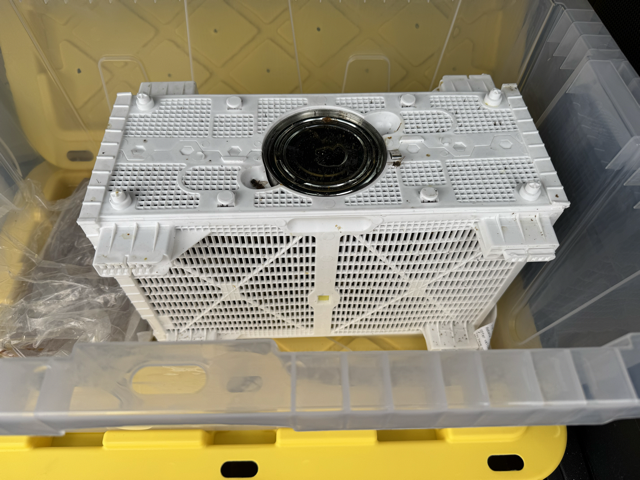
The white box contained 3 pounds of bees, the can of sugar syrup for feeding, and a small cage holding the queen. Once we picked up the bees, I drove straight to the farm and transferred them into their new hive.
Since this was my first time working with bees, I found the installation process a little unnerving. The first step is to remove the queen cage from the package and replace the cork holding her in her cage with a small marshmallow. The marshmallow acts as a temporary gate, giving the worker bees time to accept the queen before releasing her.
Once the queen cage is secured in the brood box, the remaining bees are added to the hive by pouring or firmly shaking them out of the package. As you might imagine, this gets the bees moving in a hurry. For the first time, I found myself surrounded by bees. Fortunately, the bee suit did its job and after a few minutes the bees settled down and began exploring their new home.
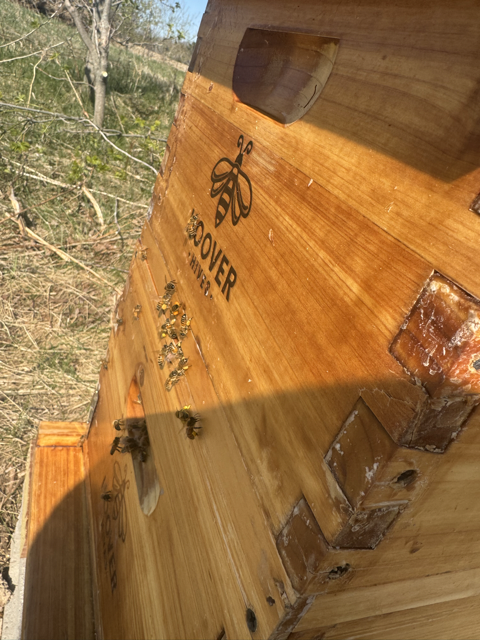
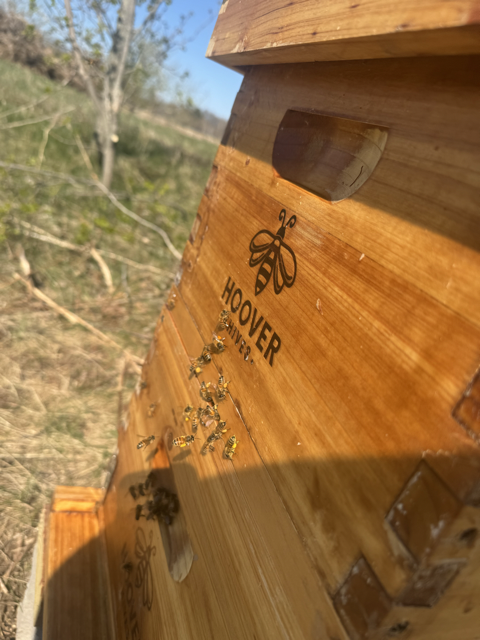
Because temperatures were still fairly cool at the farm in April, there wasn’t a great deal of activity around the hive during the first few days. As the weather warmed up, however, the colony quickly took off. Since then, the hive has been booming with activity.
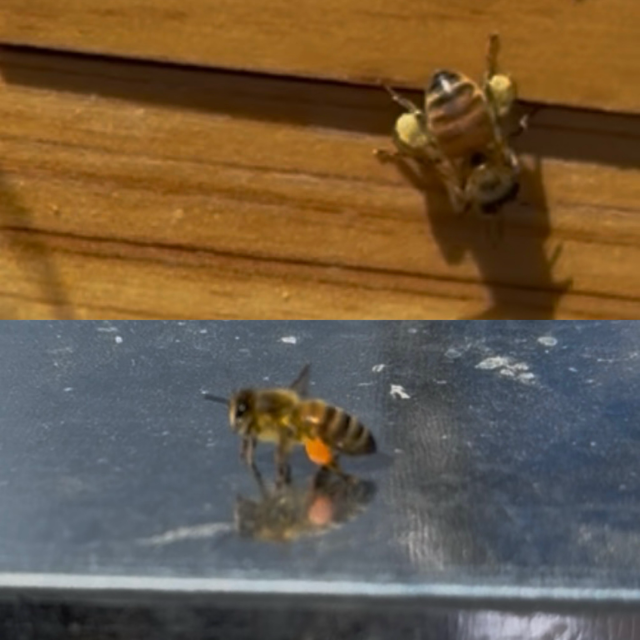
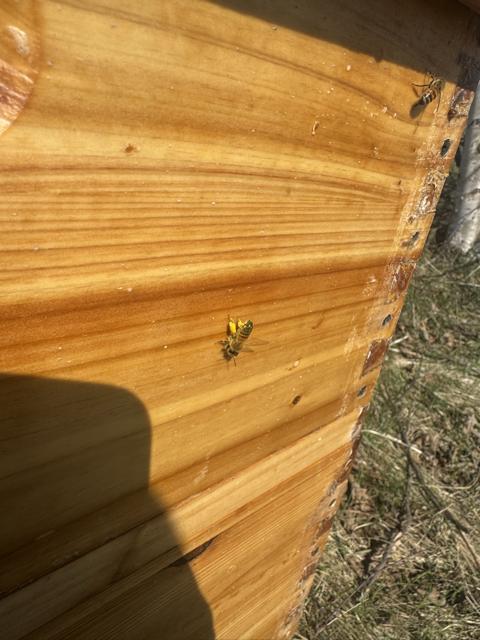
I never thought I’d hear myself say this, but I could just sit in a lawn chair near the hive and watch the bees come and go throughout the day. Many return loaded with pollen collected from nearby flowers. I especially enjoy seeing the variety of colors they bring back – from bright yellow to deep orange and everything in between. Beekeepers often refer to these colorful pollen loads as “pollen pants”, which are actually carried in special structures on the bees’ hind legs called pollen baskets.
Since installing the bees, I’ve been inspecting the hive every 7-10 days to monitor their progress. So far, they seem to be thriving. In fact, I recently added a third brood box because the bees have already filled most of the space in the first two boxes.
We’re still very much in the learning phase of our beekeeping journey, and there’s plenty left for us to learn. Even so, it’s been incredibly encouraging to see the colony growing and doing so well at the farm. We’re excited to continue learning alongside the bees and look forward to seeing how the hive develops throughout the season.
0 Comments