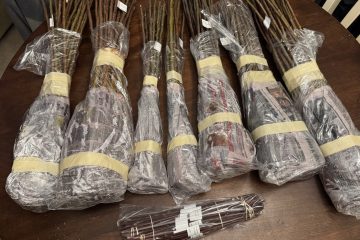
The first round of hard cider making we did in 2025 went better than I had expected and I really enjoyed the process. So this year we decided to roughly double the amount of cider we’d make. The process I followed was largely the same as I did last year. We chose to use sulfites to take care of any natural yeast and then add commercial yeasts. Last year we had done half with EC1118 and half with SafCider AB-1. While both turned out well – I found that the EC1118 made what I perceived to be was a overly dry cider. So this year about 3/4 of the bottles we did with AB1 and the other 1/4 we did with EC1118. The other change we made this year was that we bottled in 750ml champagne style bottles instead of 12oz beer bottles. We found that while we really liked the process of bottle conditioning (carbonating) the cider we thought the residual lees (dead yeast) that ends up in the bottle of the bottle to make the last pour not taste as good as the rest of the bottle.


You can of course pour slowly and limit it’s impact on the bottle but we also wanted to try disgorging the bottles. The disgorging process basically looks like this…
- Bottle condition as you normally would. We add priming sugar for this and rely on there still being active yeast in the bottle that will eat the sugar and expel CO2.
- Once the bottles age you riddle the bottles. This basically means you flip the bottles over and allow the yeast to settle in the neck of the bottle. Traditional riddling means flipping them up at an almost 90 degree angle and then rotating the bottles occasionally to ensure that all of the yeast settles in the neck.
- Once the yeast is in the neck you freeze the neck of the bottle (more to come on this in a later post) which causes the yeast to freeze into a solid little plug.
- You then disgorge the bottle by opening the bottle and allowing the built up pressure to expel the plug.
- Lastly you top of the bottle with some other cider from the process and cap it once again.
I think the process was originally developed for champagne but it’s used with other wines and ciders as well.


When I bottle this round of cider I did it in two phases. Phase 1 was bottled just I had done with the smaller bottles. I emptied the carboys into a large bucket, added 35 grams of sugar per gallon, mixed well, and the bottled it. However after I was done with the first phase I read in “The New Cider Makers Handbook” (a book Im slowly working my way though) that it’s common to add Bentonite to ciders that will be disgorged. Bentonite is typically used as a clarifying agent but it also help compact the lees in the neck of the bottle before disgorging so you get a nice plug. So for batch 2 I made it just like I made batch 2 but I added two grams of bentonite to the 4 gallons of cider at the same time I added the priming sugar. I’ll be anxious to see how batch 1 vs batch 2 handle the disgorging process.
Bottling was much easier and faster this year because of using the larger bottles. We also invested in a bench mounted crown capper which worked a lot better than the handheld unit I used last year.


So for now – these bottles will sit in the basement for 8 weeks while the bottle conditioning does its thing. After that I’ll have to build some kind of riddling rack and figure out how to build some type of cooler I can use to freeze the necks so we can disgorge them. Stay tuned for more!


0 Comments